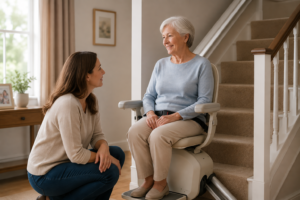

Talking to an ageing parent about mobility, safety, or a possible stairlift can be difficult. Even when the concern is reasonable, the conversation may feel personal to them.
Many older adults hear the suggestion as a sign that their family believes they are becoming incapable, losing independence, or no longer in control of their own home. This can lead to resistance before the practical benefits have even been considered.
The aim should not be to win an argument or force an immediate decision. A better approach is to open a respectful conversation, understand what your parent is experiencing, and explore possible solutions together.
Why Parents Often Resist the Idea
Resistance is common and does not necessarily mean the conversation has failed. It may simply mean your parent needs more time, information, or reassurance.
Fear of Losing Independence
A parent may believe that accepting a stairlift means admitting they can no longer manage on their own.
In reality, a mobility aid can often help preserve independence. It may allow them to continue using the whole house without waiting for assistance or avoiding certain rooms.
However, this benefit may not be obvious to them during the first conversation.
Concern About Ageing
The discussion may remind your parent of physical changes they would rather not think about.
Even a carefully worded suggestion can feel like a judgement about their age, strength, or health. They may respond defensively because the subject makes them feel vulnerable.
Attachment to the Home
Many people are protective of the appearance and character of their home. They may worry that a stairlift will make the staircase look clinical, take up too much room, or affect how visitors see them.
These concerns should be taken seriously rather than dismissed as unimportant.
Worries About Cost
Your parent may immediately think about the financial impact. They may not know how much a stairlift costs, whether rental or reconditioned options are available, or what ongoing maintenance might involve.
Some parents may also avoid discussing cost because they do not want their children to spend money on them.
A Previous Bad Experience
They may know someone who had unsuitable mobility equipment, experienced a difficult installation, or felt pressured by a salesperson.
This can create suspicion before they have explored the options themselves.
They Do Not Think the Stairs Are a Problem
Family members and parents may view the same situation differently.
You may notice hesitation, fatigue, pain, or near falls. Your parent may see these as minor inconveniences that do not justify changing the home.
Listening to their perspective is an important part of the process.
Choose the Right Moment
The timing of the conversation can make a significant difference.
Avoid raising the subject:
During an argument
While your parent is tired or unwell
Immediately after a fall, when emotions are high
In front of visitors or extended family
While rushing to an appointment
When several people are confronting them at once
Choose a calm, private moment when neither of you is under pressure.
It may be helpful to begin the discussion after your parent has mentioned difficulty with the stairs, knee pain, tiredness, or concern about falling. This allows the conversation to begin from something they have already recognised.
Start with What You Have Noticed
Try to describe specific observations rather than making general statements about their age or ability.
For example:
“I’ve noticed that the stairs seem to be taking more effort recently.”
“You mentioned that your knees hurt after going upstairs.”
“I’ve seen you pause halfway up a few times, and I wanted to ask how the stairs are feeling for you.”
This is usually more constructive than saying:
“You’re too old to use the stairs.”
“You cannot manage anymore.”
“You need a stairlift.”
The first approach opens a discussion. The second can make your parent feel judged or controlled.
Ask Before Offering a Solution
Families often begin the conversation with the solution already decided. This can make the parent feel that the decision is being made for them.
Instead, ask questions first:
How are you finding the stairs at the moment?
Is there a particular time of day when they feel more difficult?
Are you experiencing pain, tiredness, or shortness of breath?
Have you ever felt unsteady or worried about falling?
Is there anything that would make moving around the house easier?
What concerns would you have about a stairlift?
Their answers may reveal that the main problem is not what you expected.
They may be more concerned about carrying laundry, reaching the bathroom at night, getting off safely at the landing, or losing space on the staircase.
Focus on Independence, Not Decline
The way the subject is framed matters.
A stairlift should not be presented as evidence that your parent is no longer capable. It can be discussed as a practical tool that helps them remain independent and continue using their home safely.
You might say:
“This could help you keep using both floors without having to depend on anyone.”
“The idea is not to stop you doing things. It is to make moving around the house easier.”
“It may help you stay in the home you know and enjoy.”
This shifts the conversation from limitation to access and control.
Do Not Make It Sound Like an Emergency Unless It Is One
Family members may feel urgency because they are worried about a fall. However, creating pressure can make the parent more resistant.
Unless there is an immediate safety concern, it is usually better to allow the conversation to develop over time.
The first discussion may simply introduce the idea. A second conversation may involve looking at options. A later step may be arranging a home assessment.
People are often more open to change when they have time to consider it without feeling forced.
Let Them Remain Part of the Decision
Your parent should be involved in decisions about:
Whether to explore a stairlift
Which provider visits the home
The preferred seat style and colour
Where the stairlift parks
Whether a new, reconditioned, or rental option is considered
When installation takes place
Who receives service and maintenance information
Even small choices can help them feel that the process is happening with them rather than to them.
Share Information Without Overwhelming Them
Too much information in the first conversation can feel like a sales presentation.
Start with a simple explanation of what a stairlift could help with. Later, you can discuss:
Safety belts and sensors
Folding seats, armrests, and footrests
Straight and curved staircase options
Swivel seats
Battery charging
Installation time
Warranty and servicing
Rental or reconditioned models
Space required on the staircase
It may help to look at photographs or short videos together so your parent can see that modern stairlifts are often less intrusive than expected.
Suggest an Assessment, Not a Commitment
Some parents resist because they believe agreeing to a home visit means they are agreeing to buy something.
Make it clear that an assessment is simply an opportunity to understand what is possible.
You might say:
“We do not need to decide anything. We could arrange a visit, ask some questions, and see whether it would even work in the house.”
This reduces pressure and allows your parent to gather practical information.
A reputable provider should assess the staircase, discuss the user’s mobility, explain suitable options, and provide clear pricing without forcing a decision.
Involve the Right Person
Sometimes an ageing parent may respond better to someone outside the immediate family.
Depending on the situation, it may help to involve:
A trusted doctor
An occupational therapist
A physiotherapist
A carer
A close friend
A sibling they trust
Another relative who has used a stairlift
A professional mobility adviser
The aim is not to surround or pressure them. It is to give them access to someone whose opinion they respect.
Avoid Turning It into a Group Intervention
Several family members raising the issue together can feel intimidating.
Even when everyone is concerned, your parent may feel outnumbered or believe decisions are being made behind their back.
It is usually better for one trusted person to begin the conversation calmly. Other relatives can be involved later when your parent is ready.
Listen to Their Objections
Do not dismiss concerns immediately. Ask what is behind them.
If your parent says, “I do not want one,” you might respond:
“What worries you most about it?”
Their concern may be about appearance, cost, reliability, embarrassment, space, or fear of being unable to use it.
Once the real objection is understood, it becomes easier to discuss it properly.
How Other Families Often Approach the Conversation
Families handle the subject in different ways, but several approaches are commonly helpful.
Starting with a Temporary Problem
Some families begin the conversation after surgery, illness, or a period of reduced mobility.
They discuss a rental or short-term option first. Once the parent experiences the convenience and safety of the stairlift, they may become more comfortable with keeping it longer.
Framing It as Future Planning
Another approach is to discuss the stairlift before the stairs become seriously unsafe.
The family may say:
“It may be easier to look at this now, while you can choose what you want, rather than waiting until a decision has to be made quickly.”
This can help the parent see the process as forward planning rather than a response to failure.
Visiting Someone Who Already Has One
Some parents feel more comfortable after seeing a stairlift in another person’s home.
They can ask honest questions about noise, speed, appearance, daily use, and maintenance. Hearing directly from another user may feel more trustworthy than reading marketing information.
Discussing the Whole Home
Rather than focusing only on a stairlift, some families suggest a general home safety review.
This may include lighting, handrails, bathroom access, loose rugs, doorways, and the stairs. A stairlift then becomes one possible improvement rather than the only subject of concern.
Focusing on Family Reassurance
Some parents are more open when they understand how much worry the current situation causes.
You might say:
“I know the decision is yours, but I worry when you use the stairs alone. I’d feel more comfortable if we explored something that could reduce the risk.”
This should be expressed honestly, without using guilt or emotional pressure.
What to Avoid Saying
Certain phrases can quickly make the conversation confrontational.
Try to avoid statements such as:
“You have no choice.”
“You are becoming unsafe.”
“You are too old for the stairs.”
“Everyone agrees you need one.”
“We have already decided.”
“You are being stubborn.”
“You are going to fall.”
“It is for your own good.”
Even when the concern is genuine, these phrases can make your parent feel powerless.
What to Do If They Still Say No
Your parent may continue to refuse the idea. If they are able to make their own decisions, their choice should be respected, even when you disagree.
You can still take constructive steps:
Keep the conversation open
Ask whether they would consider another option
Improve lighting around the stairs
Install or strengthen handrails
Remove clutter and trip hazards
Move frequently used items to one floor
Discuss the situation with a healthcare professional
Revisit the subject later
Agree on what should happen if mobility changes
Sometimes the most useful outcome of the first conversation is simply that the subject is no longer completely new.
When More Urgent Action May Be Needed
A more immediate assessment may be necessary if your parent has:
Experienced repeated falls or near falls
Become unable to reach essential rooms
Started sleeping in an unsuitable downstairs space
Lost the ability to use the stairs safely
Developed rapidly changing mobility needs
Become dependent on unsafe physical assistance
Been advised by a healthcare professional to avoid stairs
In these circumstances, discuss the situation with an occupational therapist, doctor, physiotherapist, or appropriate mobility professional.
A stairlift may be suitable, but other adaptations or care arrangements may also need to be considered.
Final Thoughts
Raising the subject of a stairlift with an ageing parent requires patience, respect, and careful timing.
Most resistance comes from understandable concerns about independence, identity, cost, appearance, or control. Listening to those concerns is usually more effective than trying to overcome them immediately.
Begin with what you have noticed, ask how your parent feels, and explore the available options together. The goal is not to force a decision. It is to help them remain safe, independent, and involved in choices about their own home and daily life.