Deciding whether a parent needs a stairlift can feel difficult. Families often notice small changes first, such as hesitation on the stairs, holding the handrail more tightly, or avoiding certain rooms in the home.
A stairlift can improve safety and independence, but it is not always the only or best solution. The decision should be based on your parent’s mobility, confidence, health, home layout, and long-term needs.
This guide explains the early signs families commonly notice, the questions to discuss together, and the situations where another solution may be more suitable.
The Early Signs Families Often Notice
Mobility changes do not always happen suddenly. In many cases, family members begin noticing small changes over time.
Avoiding the Stairs
Your parent may begin spending more time on one floor of the home. They might avoid going upstairs during the day or delay tasks that require using the staircase.
They may also start sleeping downstairs or using a different bathroom because climbing the stairs feels tiring or uncomfortable.
Holding the Handrail More Tightly
Using the handrail is normal, but relying on it heavily may indicate reduced balance, strength, or confidence.
You may notice your parent pulling themselves upward, pausing between steps, or using both hands for additional support.
Taking Longer to Use the Stairs
A staircase that once took a few seconds may begin taking several minutes. Your parent may stop halfway, breathe heavily, or appear physically exhausted after reaching the landing.
This can be caused by reduced strength, joint pain, breathing difficulties, or fear of falling.
Previous Slips or Near Falls
A fall does not need to cause an injury to be serious. A slip, stumble, or near fall can affect confidence and make future stair use more stressful.
Some parents may not mention these incidents because they do not want their family to worry. Look for changes in behaviour, such as sudden hesitation or refusing to use the stairs alone.
Pain While Climbing
Pain in the knees, hips, back, ankles, or feet can make stair use difficult. Climbing usually places more pressure on the joints than walking on a flat surface.
Your parent may not describe the pain directly, but they may move more slowly, make visible efforts, or avoid unnecessary trips between floors.
Carrying Items Has Become Difficult
Laundry, drinks, books, medication, and personal belongings can become difficult to carry safely on the stairs.
If your parent needs both hands for balance, carrying even a small item may increase the risk of falling.
Increased Fear or Anxiety
Some parents remain physically capable of using the stairs but feel nervous every time they do so.
This fear may follow a fall, illness, surgery, or a general reduction in confidence. Anxiety can cause stiffness, rushed movements, or hesitation, which may further increase the risk of an accident.
Questions to Consider Together
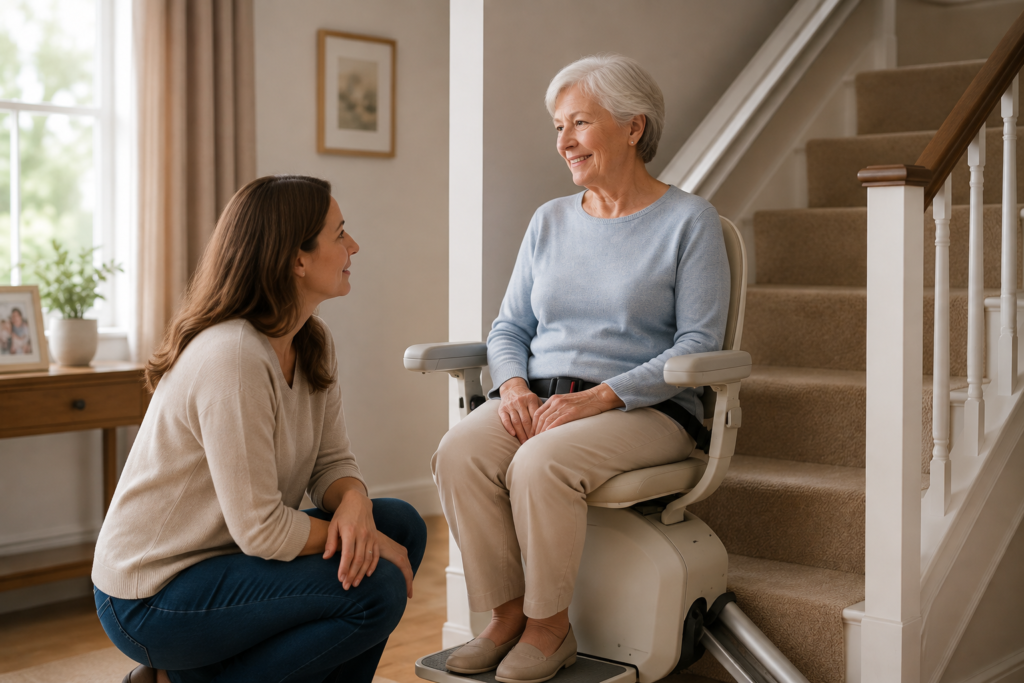
The decision should involve your parent whenever possible. A stairlift affects their daily routine, independence, and home environment, so their opinion matters.
How Often Do They Need to Use the Stairs?
Consider how many times your parent moves between floors each day.
If the bedroom, bathroom, kitchen, or main living space is located upstairs, avoiding the staircase may significantly limit daily life.
A stairlift can help restore access to areas of the home that have become difficult to reach.
Can They Sit and Transfer Safely?
A stairlift user usually needs to:
Sit down on the stairlift seat
Remain seated during the journey
Use a safety belt
Place their feet on the footrest
Stand up or transfer at the landing
Some users may need support from a family member or carer. The installer should assess whether the seat, swivel function, controls, and landing position are appropriate.
Can They Use the Controls?
Most stairlifts have simple controls, but the user still needs to understand how to start, stop, and operate the lift safely.
If your parent has reduced hand strength, limited movement, or difficulty understanding instructions, ask about alternative control options and remote controls.
Is the Staircase Suitable?
Stairlifts can be installed on many straight, curved, narrow, or multi-level staircases. However, the available space, staircase width, landing area, door positions, and rail design all need to be assessed.
A professional home survey should confirm whether the lift can be installed without creating additional hazards.
Will Other People Still Need to Use the Stairs?
In a shared home, the stairlift should not prevent other family members from using the staircase safely.
Many stairlift seats, armrests, and footrests can be folded when not in use. The installer should check that enough walking space will remain.
Is the Need Temporary or Long-Term?
A stairlift may be required after surgery or during rehabilitation, or it may form part of a long-term mobility plan.
Understanding the likely duration can help families compare new, reconditioned, rental, and removal options.
What Does Your Parent Want?
Some parents may initially resist the idea because they associate a stairlift with losing independence.
In reality, a stairlift can help preserve independence by allowing them to continue using the whole home without relying on someone else for every journey.
The conversation should focus on safety, comfort, access, and personal choice rather than age alone.
Benefits a Stairlift Can Provide
When suitable, a stairlift can provide several practical benefits.
Safer Access Between Floors
A stairlift reduces the physical effort and balance required to climb stairs. Safety belts, footrests, sensors, and controlled movement can make journeys more predictable.
Greater Independence
Your parent may be able to move between floors without waiting for help. This can support privacy, confidence, and control over their daily routine.
Continued Use of the Home
A stairlift may reduce the need to move a bedroom downstairs or relocate to another property.
It allows your parent to continue accessing familiar rooms, belongings, and routines.
Reduced Pressure on Family Members
Family members may feel less anxious about falls or difficult stair transfers.
A stairlift does not replace care when care is needed, but it can reduce the level of assistance required for basic movement around the home.
When a Stairlift May Not Be the Right Answer
A stairlift is not suitable for every person or every situation. A professional assessment is important before making a decision.
The User Cannot Sit Safely
If your parent cannot maintain a stable seated position, a standard seated stairlift may not be appropriate.
A standing, perch, platform, or through-floor lift may be considered depending on their condition and the property.
Transfers Are Unsafe
The most challenging part may not be the journey itself, but getting on and off the lift.
If your parent is unable to transfer safely at the top or bottom landing, another mobility solution may be required.
Significant Cognitive Difficulties
A stairlift may not be appropriate if the user cannot understand or remember how to operate it safely.
In some cases, supervised use may still be possible. This should be discussed with healthcare professionals, carers, and the installer.
The Staircase Creates Serious Installation Limitations
Some staircases may be extremely narrow or have insufficient space at the landings.
Doors, radiators, low ceilings, or unusual structural features may also affect installation. Alternative routes or equipment may need to be considered.
The Parent Needs Full Wheelchair Access
A standard stairlift requires the user to transfer from a wheelchair to the seat.
If independent wheelchair access between floors is needed, a platform lift, home lift, or through-floor lift may be more appropriate.
Their Mobility Is Changing Rapidly
If your parent’s condition is progressing quickly, a solution that works today may not meet their needs in the near future.
A broader mobility and care assessment can help avoid investing in equipment that may soon become unsuitable.
The Main Risk Is Elsewhere in the Home
The stairs may not be the only concern. Slippery floors, poor lighting, loose rugs, bathroom access, clutter, and unsuitable furniture may also create risks.
A complete home safety assessment may identify other changes that should be made alongside or instead of a stairlift.
Other Options to Consider
Depending on your parent’s needs, alternatives may include:
Installing additional handrails
Improving staircase lighting
Adding contrasting stair-edge markings
Moving essential rooms to one floor
Using a downstairs bedroom or bathroom
Installing a platform or through-floor lift
Receiving physiotherapy or mobility support
Using professional carers for transfers
Moving to a more accessible property
The right answer may involve more than one change.
How to Start the Conversation
Choose a calm moment and avoid making the decision during an argument or immediately after a frightening incident.
Explain what you have noticed without making your parent feel criticised.
You might say:
“I’ve noticed the stairs seem more tiring recently, and I’d like us to look at some options that could make things safer and easier.”
Ask what they find most difficult and what outcome they would prefer. They may be more concerned about pain, fatigue, independence, appearance, cost, or disruption than you realise.
Arrange a Professional Assessment
A reputable stairlift provider should visit the home, inspect the staircase, discuss the user’s mobility, and explain the available options.
The assessment should cover:
Staircase measurements
Entry and exit positions
Seat and footrest requirements
Control options
Charging points
Folding space
Safety features
Installation limitations
Warranty and servicing
Emergency procedures
Avoid choosing a stairlift based only on price or photographs. The equipment must suit both the user and the property.
Final Thoughts
A stairlift may be right for your parent if the stairs have become painful, tiring, unsafe, or emotionally stressful, but they can still sit, transfer, and operate the lift safely.
The decision should be made together and supported by a professional assessment. In some cases, another type of lift, home modification, care arrangement, or living setup may be more suitable.
The goal is not simply to install equipment. It is to help your parent move around their home with greater safety, dignity, confidence, and independence.